Peacock Theatre, London
Running time: 1hr 40mins
Age Restrictions: This production is not suitable for anyone under the age of 15.
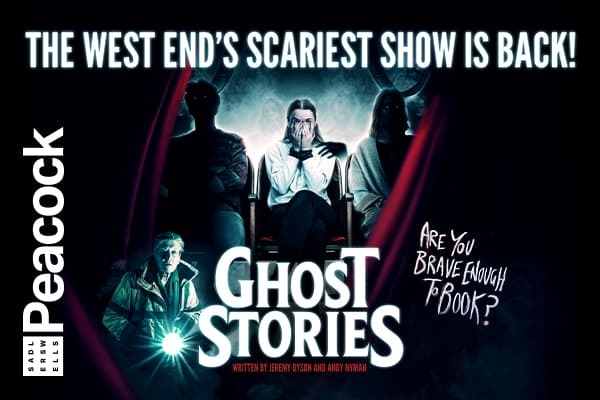
'An immaculately crafted evening of entertainment' - *Time Out*
A truly terrifying theatrical experience created by The League of Gentlemen’s **Jeremy Dyson**, and **Andy Nyman**, co-creator and director of **Derren Brown**’s television and stage shows. *Ghost Stories* mixes the very best of theatre with the buzz of a thrill-ride, delivering something truly unique.
When Professor Goodman, arch-sceptic out to debunk the paranormal, embarks on an
investigation of three apparent hauntings – as recounted by a night-watchman, a teenage boy, and a businessman awaiting his first child – Goodman finds himself at the outer limits of
rationality, and fast running out of explanations.
After exhilarating audiences for three years in the West End and across the world with record
breaking, sell-out productions and a smash hit film, Ghost Stories is back in London for a strictly limited, 6-week Halloween season run.
Hailed by *Daily Express* as a ‘truly terrifying theatrical experience’, Ghost Stories is a worldwide phenomenon more spine-tingling and exhilaratingly haunting than ever.
Are you brave enough to book?
‘I had to sleep with the lights on’ - *Metro*
Peacock Theatre
Peacock Theatre
Portugal Street, Kingsway
London
WC2A 2HT
The Peacock Theatre is a West End theatre in the City of Westminster, London, located in Portugal Street, near Aldwych. The 999-seat house is owned by, and comprises part of the London School of Economics and Political Science campus, who utilise the theatre for lectures, public talks, conferences, political speeches and open days. The university has a long lease with Sadler's Wells with whom it has negotiated a deal to bring in commercial companies under the banner "Sadler's Wells in the West End". The Peacock Theatre often plays host to dance performances, conferences, ballet, pop concerts and award ceremonies. The stage is approximately 36 feet (11 m) by 33 feet (10 m).
The Peacock Theatre, London: History
A theatre has stood on the site since the 17th century. Known as Gibbon's Tennis Court, or the Vere Street Theatre. Mrs Hughes became the first (identified) woman to tread the boards of a London theatre, on 8 December 1660, in a performance of Othello. The company left the theatre in 1663 and there is no record of further plays at the theatre. The building was finally destroyed by a fire in 1809.
At the beginning of the 20th century, the creation of Aldwych and Kingsway, linking High Holborn and Aldwych, destroyed a number of established London playhouses and the site between Portugal Street and Sardinia Street became available. Oscar Hammerstein II commissioned Bertie Crewe, to build a new theatre in the Beaux-Arts style. The theatre opened on 13 November 1911 as the London Opera House. It had an approximately 45 feet (13.7 m) by 78 feet (23.8 m) stage, and a capacity of 2,660. As an opera house, it found it difficult to attract audiences from the Royal Opera House, and from 1914–15 the house became the National Theatre of England.
The theatre was purchased by Oswald Stoll in 1916 and renamed the Stoll Theatre and, for a time, as the Stoll Picture Theatre, housing cine variety until the 1950s. Rose Marie played at the Stoll Theatre in 1942, followed by Kismet and Stars on Ice in 1947. The London transfer of a version of George Gershwin's Porgy and Bess that restored it to an operatic form, took place here on 9 October 1952. Joan of Arc at the Stake was produced in 1954, starring Ingrid Bergman. The theatre closed on 4 August 1957, and was demolished for the construction of an office block.
The Peacock Theatre: Current Building
The present, smaller theatre was built and christened The Royalty Theatre in 1960, located on the basement level of an office building. It was the first West End theatre to be built since the Saville Theatre in 1931. The MGM film Ben Hur played at the theatre in 1961. Mutiny on the Bounty played next, and the theatre was then equipped for screening Cinerama films becoming London's third Cinerama theatre (the others being the Casino Cinerama and the Coliseum Cinerama). The theatre only premièred one Cinerama film, The Golden Head, however. In 1966, the house returned to live theatre use. The Royalty Theatre's only successes were a run of the hit Calcutta and a hit production of Bubbling Brown Sugar in the late 1970s. Spectacular 'follies' style shows and 'drag' shows didn't find an audience, and the theatre became used as a TV studio for This is Your Life, but was later bought by the London School of Economics and renamed The Peacock Theatre.
When Sadler's Wells determined to build its new theatre in 1996, the company moved to the West End's Peacock Theatre. After the new Sadler's Wells Theatre opened in 1998, The Peacock became a dance venue for the company. The Rat Pack played at the theatre in 2002, and Doldrum Bay premièred here in 2003. The house is now shared between the London School of Economics (during the day) and Sadler's Wells evening dance productions.
The Peacock Theatre is most noted as the home of one of the West End's most unusual ghosts, a dolphin commonly known as 'Flipper'. An urban myth has grown that during one of Paul Raymond's revues at the theatre in the 1970s, a dolphin was kept in a tank beneath the stage, where it lived permanently and later died from neglect. In fact, this is not true. Indeed two dolphins 'Pennie' and 'Pixie' were kept in the theatre in a tank for three months for a show called 'The Royalty Folies' later renamed 'The Great International Nude Show'. However neither of these animals died whist at the theatre and at the close of the show the animals were moved to a dolphinarium in the far east. The remnants of the tank and its lifting equipment still remain below the stage and numerous visitors to the theatre claim to have heard a spectral squeaking, not unlike a crying baby when in the vicinity. One possible explanation is that the London Underground passes very close to the substage areas of the theatre and it is noise from the tunnels that creates the sound.
Travel by train: Charing Cross. Nearest tube: Holborn
I highly recommend this show. Great show, great twist, a definite must see.
Posted anonymously on 05/01/2020
Ghost Stories, Ambassadors Theatre, London - 27th December 2019
The sets, special effects, audio and smells were all excellent and made for an immersive and jumpy theatre experience for the audience. Would recommend to anyone who likes being scared / horror. Not a usual theatre show.
Posted by Charlie on 18/12/2019
Ghost Stories, Ambassadors Theatre, London - 16th December 2019