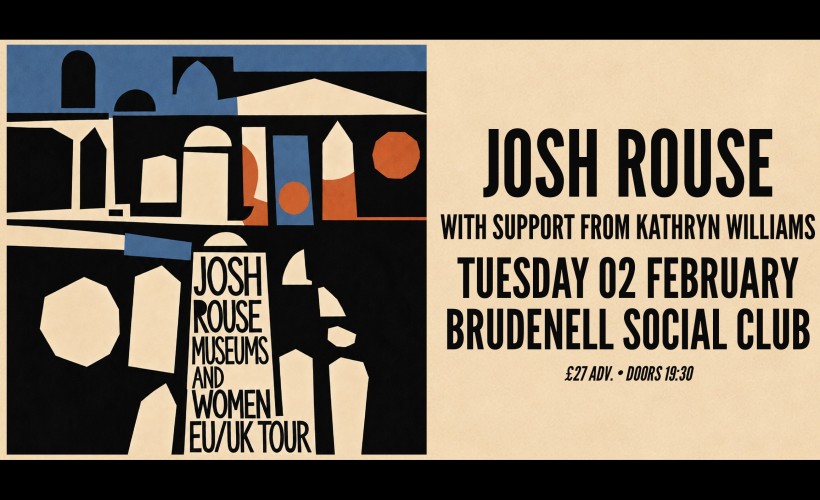
On his gorgeous new album, Museums and Women, Josh Rouse is part songwriter, part street photographer, an itinerant documentarian traveling the world capturing evocative portraits that reveal not only the rich inner lives of his subjects, but also the tender soul of the man behind the lens. "I was drawn to these songs because they're so observational," Rouse reflects. "They're full of characters and stories I dreamed up from little moments that sparked my imagination on the road. At the end of the day, though, it's inevitable that I'm in there somewhere, too." Recorded in Nashville with longtime production partner Brad Jones (Chuck Prophet, Hayes Carll), Museums and Women showcases Rouse at his most hopeful and romantic, balancing casual poetry and wry humor in equal measure as he conjures up a cast full of drifters and dreamers moving through life with quiet satisfaction. The subjects of these songs are almost always in transit, but never lost; searching, but never desperate; longing, but never lonely. The music, meanwhile, is often bittersweet, with a gentle, seemingly placid surface that belies the deep well of emotion and memory and desire underneath. The result is a lush, cinematic exploration of the endless stream of passing strangers who slip in and out of our lives on a daily basis, a professional people watcher's take on the external worlds we carry within, the internal worlds we map onto others, and the real world that lies somewhere in between. "When I was writing these songs, I was trying to envision the entire scene, to create a fully fleshed out place where I could go while performing the music," Rouse explains. "I wanted to make it as real for the audience as it was for me."Hailed by NPR as "one of contemporary music's most engaging singer-songwriters," Rouse first emerged with his stunning 1998 debut, Dressed Up Like Nebraska, which Billboard proclaimed to be a "dark horse gem." In the years to come, he would go on to release thirteen more critically acclaimed albums, homing in on a warm, ruminative sound that fused elements of vintage folk, roots rock, and AM pop with a distinctly modern and emotionally insightful perspective. Q called his 2003 breakout release, 1972, "the most intimate record of the year," while Rolling Stone dubbed his follow-up, Nashville, "a landmark album," and EW described 2013's The Happiness Waltz as "a big contender for Rouse's best work." After moving to Spain, where he lived for a little more than a decade, Rouse won a Goya Award (the Spanish equivalent of an Oscar) for his song "Do You Really Want To Be In Love," and since returning to the States in 2018 with his wife and children, he's continued to tour and record at a relentless clip, performing everywhere from Glastonbury to Massey Hall. "I don't feel like I have anything to prove at this point in my career," Rouse explains. "I feel very rich in life that I'm still able to continue doing what I love, and my sole motivation remains the joy that I get from writing and performing."It was that joy that compelled Rouse to return to the studio in the fall of 2024, despite having no specific plans for a new album at the time. "I was between labels," Rouse says, "so when Brad invited me to spend a day recording with him, I didn't really have an agenda. The experience was just so effortless and enjoyable that we kept doing it every few months until we had a full album's worth of material on our hands." The sessions were quick and raw, with Rouse on guitar, Jones on bass, and Fred Eltringham (Sheryl Crow, The Chicks) on drums. The trio would record live in the morning, cutting multiple tunes in a row before returning in the afternoon to complete overdubs while the music was still fresh and new. "At a certain point, Brad had this folder full of recordings on his desktop, and he asked me what to call it," Rouse remembers. "I suggested Museums and Women because it was the name of a John Updike book I'd always loved, and it just felt right for the kind of stories I was telling." Indeed, Museums and Women is a particularly fitting title for a collection that observes its subjects from a reverent distance, elevating ordinary moments of human connection (or lack thereof) into gallery-worthy masterpieces. Album opener "Spring" sets the stage, with Rouse's narrator offering to bring a little color into a potential lover's cold, gray world. "Winter's way too long, baby / Waitin' for the sun to shine," he sings over a mix of jangly acoustics and languid slide guitar. "We could have some fun maybe / I could bring the spring." Like much of the album, the track is rooted in a relentless optimism, an absolute faith in the power of love to lead us where we're meant to be. The breezy "January Sky" finds peace and contentment in truly being seen by a partner, while the bossa nova-tinged "Sunday In The Country" trades hustle and ambition for the simple joys of slow living, and the infectious "Things Are Looking Up" learns to look on the bright side. "You don't have to be on your own," Rouse's narrator sings to a fellow drinker at the bar. "I could help you with a thing or two." "There's a bit of mystery to all these songs," Rouse explains, "but there's always a woman involved. Love-or the search for it-is what ties them all together." The dreamy "Other Side Of The Tracks," for instance, turns a passing glance into a whirlwind romance on the California coast ("I just wanted to know you / Your life looked like some fun / Could I be part of it?"). The intoxicating "Parnell Street," on the other hand, never manages to make the connection, but still finds pleasure walking the rainy streets of Dublin and knowing that life is full of possibility (There's so many people in the world / There's so many redheaded girls / And here I am tonight / It feels so good to be alive"). And while Rouse's characters are rarely rooted in any kind of permanent way-tracks like airy "Short-Order Cook" and charming "Wanderlust" follow subjects who live their lives perpetually on the move-their yearning for what comes next is never presented as a flaw or shortcoming, but rather as a beautiful and essential part of their humanity. "Step right in, watch your tone / No touching things that you don't own," Rouse sings on the title track, his narrator drifting through a gallery where the line between patrons and exhibits is blurry at best. On Museums and Women, everyone is both a work in progress and a work of art. Even the artist himself.